## Why a Broken Water Line Demands Your Immediate Attention
A **broken water line** can turn your home into a disaster zone fast. Water pooling in your yard, a sudden spike in your utility bill, or muddy sinkholes near your foundation are all red flags that something's wrong underground. In the United States, more than 240,000 water mains break every year, and while some breaks happen on public property, many occur on the private service line that you're responsible for maintaining. For Wisconsin homeowners, the freeze-thaw cycles we experience make this problem even more urgent. This guide will walk you through how to identify a broken water line, understand who's responsible for repairs, and take immediate action to protect your home and family.
If you're dealing with any plumbing emergency, learn more about our [comprehensive plumbing services](/plumbing) or [contact Aliance Home Services for emergency help](/contact).
**Quick Answer: Top 5 Signs of a Broken Water Line**
1. **Unexplained high water bills**
2. **Sudden drop in water pressure** – Affecting multiple fixtures throughout your home
3. **Puddles or soggy spots in your yard** – Especially during dry weather
4. **Discolored or rusty water** – Coming from multiple taps
5. **Strange sounds** – Hissing, bubbling, or gurgling from pipes
These signs often appear together. If you notice even one, it's time to investigate. A broken water line won't fix itself, and the damage only gets worse with time. Foundation damage, contaminated water, and structural issues can all stem from an ignored leak.

## Telltale Signs: How to Spot a Potential Break
When a **broken water line** strikes, it rarely announces itself with a flashing neon sign. Instead, it often presents a series of subtle and not-so-subtle clues that, if recognized early, can save you from extensive damage and costly repairs. We recommend keeping a watchful eye on your property for any of these indicators.
One of the most common early warnings is an **unexplained high water bill**. Our average American family uses around 80-100 gallons of water per day. If your water usage habits haven't changed, but your monthly bill keeps climbing, a hidden leak is the most likely culprit.
Another significant sign is a **sudden drop in water pressure** throughout your home, affecting multiple fixtures. If water is escaping your system before it reaches your faucets and showers, you'll feel the difference. This could be due to a significant leak or a blockage in the main line.
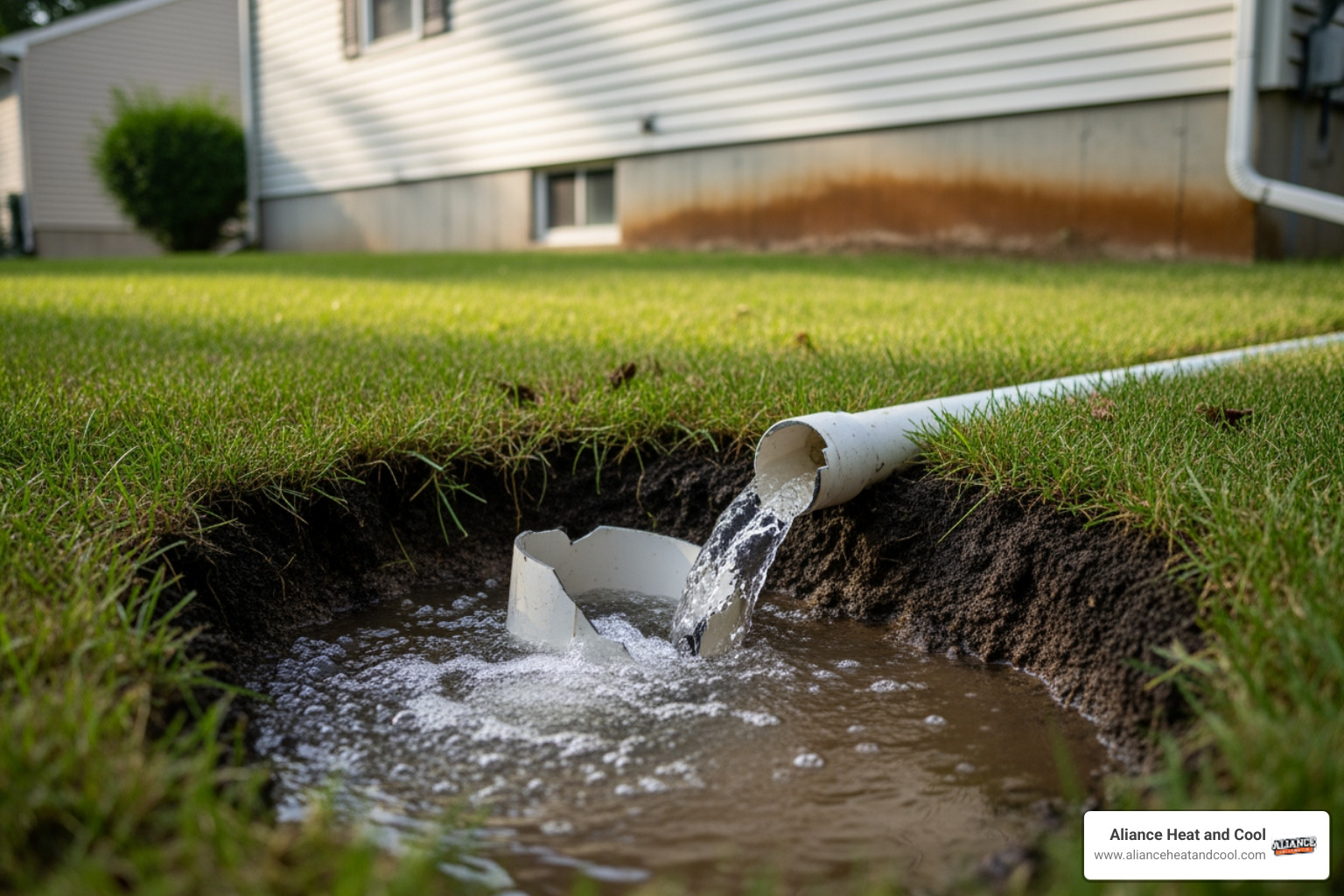
Outdoors, look for **puddles or soggy spots in the yard** that appear even during dry weather. These unexplained wet areas are often where water from a subterranean leak is surfacing. In more severe cases, you might even notice **muddy sinkholes** forming.
Indoors, **discolored or rusty water** coming from multiple taps is a serious indicator. This can mean sediment, rust, or even contaminants from the surrounding soil are entering your water supply through a breach in the pipe.
Keep your ears open for **strange noises** like hissing or bubbling coming from your pipes, especially when no water fixtures are in use. These sounds can indicate water escaping under pressure or air entering the system through a leak.
Beyond these primary indicators, other signs include **foundation cracks** appearing in your home, which can be caused by shifting soil due to excessive moisture from a leak. You might also spot **damp drywall or water stains** on ceilings and walls, signaling an interior leak or water seeping through the structure. Finally, a sudden increase in **pest infestations**, particularly those attracted to moisture like insects, can sometimes point to a hidden water source from a leak.
If you suspect any kind of leak, our [Leak Detection services](/plumbing/leak-detection) can help pinpoint the problem.
### Visible Clues in Your Yard and Home
Sometimes, a **broken water line** makes itself quite obvious. **Water pooling** in your yard or street, even when there hasn't been any rain, is a clear indicator. This is often accompanied by **water bubbling from the ground**, resembling a small spring. In extreme cases, a significant break can lead to visible **flooding** or the formation of **sinkholes**, which are not only damaging but also dangerous. These visible signs outside your home, including those indicating [damaged water mains and pipes](https://water.phila.gov/drops/water-infrastructure-emergencies), demand immediate attention. Inside your home, look for **watermarks on walls or ceilings**, which suggest water is seeping through from a hidden leak above or behind the surface.
### Subtle Indicators of a Broken Water Line
Not all signs of a **broken water line** are as dramatic as a geyser in your front yard. Many are more subtle, requiring careful observation. As mentioned, **low water pressure across all fixtures** is a key indicator. If only one faucet is affected, it might be a fixture issue, but if your entire home experiences a pressure drop, the problem is likely in your main water line.
**Unexplained spikes in water bills** are another subtle but critical clue. We know that on average, an American uses [around 80-100 gallons of water] per day. If your household's consumption hasn't changed, but your bill has, a hidden leak is probably wasting water.
**Noisy pipes or fixtures** can also signal trouble. Banging, clanging, or even a persistent gurgling sound when water isn't running actively can indicate air in the lines or water struggling through a blockage or escaping a leak. Lastly, a persistent **musty odor** in your home, especially in areas like basements or crawl spaces, can point to hidden moisture and mold growth caused by a slow, undetected leak.
## Water Main vs. Service Line: Who is Responsible?
Understanding who is responsible for repairing a **broken water line** is crucial, as it determines who pays for the fix and who to call. The answer depends on where the break occurs relative to your property line.
| Feature | Water Main | Water Service Line |
| --- | --- | --- |
| **Definition** | Large pipes installed by the city/municipality | Smaller pipes branching off the main, supplying individual properties |
| **Ownership** | Public (city, local water utility) | Private (homeowner) |
| **Responsibility** | City/Local Water Utility | Homeowner (from the curb box to the home) |
| **Location** | Under streets or public easements | From the connection point at the main (often near the curb box) to your home's entry |
A **water main** is the large pipe installed by the city or local water utility that carries water for miles, distributing it throughout neighborhoods. These are typically located under streets or public easements. Repairs to these public mains are generally the responsibility of the city or local water utility.
Your **water service line**, on the other hand, is the smaller pipe that branches off the water main to supply water directly to your individual property. This line typically connects to the water main at a point near your property line, often marked by a **curb box** (a small access point with a lid that says "Water"). From this curb box to your home's entry point, the water service line is considered your private property, and therefore, its repair is the homeowner's responsibility. The distinction between a [water main and service line break](https://www.gd-pud.org/water-main-and-service-line-break) is vital for knowing your obligations.
### The City's Role
When a **broken water line** occurs on a public **water main**, it falls under the jurisdiction of your local water utility. Their responsibilities include:
- **Repairing public water mains:** Crews are dispatched to fix breaks in the large distribution lines.
- **Managing the public right-of-way:** They handle the necessary excavation and road repair in public areas.
- **Notifying residents of outages:** In cases of major breaks or necessary shut-offs, the city will inform affected residents, often through social media, website updates, or door hangers. They also work to provide information on [about water main breaks](https://www.portland.gov/water/about-portlands-water-system/fixing-main-breaks) and their repair process.
If you suspect a break on a public water main, report it to your local water utility immediately.
### The Homeowner's Role
For a **broken water line** on your property's **water service line**, the responsibility typically rests with you, the homeowner. This extends from the curb box (or property line connection) all the way to your house. Your role includes:
- **Repairing the private service line:** This involves locating the leak and arranging for its repair or replacement.
- **Hiring a professional plumber:** Since these lines are underground and critical to your home's function, it's best to enlist experienced professionals like us to diagnose and fix the problem.
- Understanding that issues like a [pipe leak or burst](https://www.toronto.ca/services-payments/water-environment/pipe-leak-or-burst/) on your side of the property line are your responsibility.
## Common Culprits: What Causes Water Line Breaks?
A **broken water line** doesn't just happen out of the blue; there are several underlying factors that contribute to these frustrating plumbing emergencies. Understanding these causes can help us take preventative measures.
One of the most significant factors is **pipe corrosion and age**. As pipes get older, especially those made of metal, they naturally corrode and weaken, making them more susceptible to leaks and breaks. Modern piping materials are generally less prone to corrosion than outdated ones, but even newer pipes have a lifespan.
**Shifting soil** is another common culprit. Natural ground movement due to erosion, seismic activity (though less common in Wisconsin), or even heavy vehicle traffic can put immense pressure on underground pipes, leading to cracks or disconnections.
For us here in Wisconsin, **freeze-thaw cycles** are a major cause of water line breaks. When water freezes in the ground, it expands, putting stress on pipes. As the ground thaws, it contracts, and this constant expansion and contraction can cause pipes to crack or rupture. This is particularly true in colder winter months when pipes become more brittle.
**Tree root intrusion** is a surprisingly common problem. Tree roots are naturally drawn to water sources and can infiltrate pipes through tiny cracks or loose joints, growing inside and eventually causing blockages or breaks.
**High water pressure**, while seemingly beneficial, can also stress your plumbing system over time. Consistently high pressure can weaken pipe walls and connections, leading to eventual failure.
Sometimes, a **broken water line** can be attributed to **improper installation**. If pipes weren't laid correctly, or connections weren't sealed properly, they are more prone to failure down the line. Finally, **accidental damage from digging** is a significant risk. This is why it's always crucial to call before you dig to avoid striking buried utility lines.
### Environmental Factors Leading to a Broken Water Line
Our environment plays a substantial role in the integrity of our underground water lines. **Ground movement**, whether from natural geological shifts, soil erosion, or even construction nearby, constantly exerts force on buried pipes. This can cause them to shift, bend, or crack.
**Extreme temperatures**, particularly the harsh winters and fluctuating spring and fall temperatures we experience in Wisconsin, are especially hard on water lines. The repeated **freeze-thaw cycles** cause the ground to expand and contract, placing immense stress on pipes. Cold water itself can make pipes more brittle, increasing their vulnerability.
Changes in **soil composition** and moisture content can also contribute. Very wet or very dry soil can behave differently, causing pipes to move or settle unevenly. The interaction between your pipes and the surrounding environment is a critical factor in preventing a [pipe leak or burst](https://www.toronto.ca/services-payments/water-environment/your-water-pipes-meter/water-related-help-advice/pipe-leak-or-burst/).
### Material and Age-Related Failures
The materials your water lines are made from, and their age, are primary determinants of their susceptibility to breaking. **Corrosion of old pipes**, especially those made of galvanized steel or cast iron, is a leading cause of leaks. Over decades, these materials can rust and degrade from the inside out, weakening the pipe walls until they can no longer withstand water pressure.
**Outdated piping materials** are generally more prone to failure than modern ones. While newer plastics and copper are more resilient, older homes in our service areas like West Bend, Wauwatosa, or Sheboygan might still have original piping that's well past its expected lifespan.
A general **lack of maintenance** also contributes significantly. While you can't typically "maintain" a buried water line in the traditional sense, knowing its age and material, and performing regular inspections of your overall plumbing system, can help identify potential issues before they become full-blown breaks. If your pipes are aging or showing signs of frequent issues, our [Pipe Replacement services](/plumbing/pipe-replacement) can provide a long-term solution.
## Emergency Action Plan for a Suspected Broken Water Line
Finding a **broken water line** can be alarming, but knowing what to do immediately can mitigate damage and help support your family's safety. Here's our recommended emergency action plan:
1. **Shut off the main water supply:** This is the most critical first step to stop the flow of water and prevent further damage.
2. **Limit all water usage:** Avoid flushing toilets, running faucets, or using appliances that consume water.
3. **Call for professional help:** Contact us or your local water utility right away.
4. **Document the damage:** Take photos and videos for insurance purposes.
5. **Assess health risks and water safety:** Be cautious about using tap water.
6. **Check your homeowners insurance coverage:** Understand your policy's limitations and endorsements.
### Step 1: Shut Off the Water and Call for Help
The very first thing you need to do if you suspect a **broken water line** is to stop the water flow. Locate your **main water shut-off valve**. This is typically found where the water line enters your home, often in the basement, crawl space, near your water heater, or outside near the curb box. Turn the valve clockwise until the water flow completely stops. If you can't find it or it's not working, contact your local water utility immediately to have them shut off the water at the street.
Once the water is off, **call for professional help**. A broken water line is a serious issue that requires expert attention. Our team at Aliance Home Services provides [Emergency Plumbing Services](/plumbing/plumbing-emergency-plumbing) across Southeastern Wisconsin, ready to respond quickly to diagnose and repair the problem.
### Step 2: Assess Health Risks and Insurance
A **broken water line** can pose **potential health risks**, especially if there's a chance of water contamination. When a pipe breaks, it can draw in surrounding soil, dirt, and even wastewater if there's a nearby sewer line breach. This can introduce pathogens like E. coli, viruses, and protozoans into your drinking water supply. If your water is discolored or has an unusual odor after a break, it's safer to avoid using it for drinking, cooking, or brushing teeth. We recommend using bottled water or boiling tap water vigorously for at least one minute before consumption. If your water service is impacted, you should [use water from your emergency water supply](https://www.regionalh2o.org/emergency-preparedness/emergency-water-storage).
Next, it's important to **check your homeowners insurance policy**. Standard homeowners insurance policies often do not cover damage from main water line breaks or the resulting water damage if the break is outside your home on your service line. However, many policies offer a "service line endorsement" or "utility line coverage" that you can add to your policy. This endorsement can provide coverage for the repair or replacement of damaged service lines, including your water line, from the property line to your home. Contact your insurance provider as soon as possible to understand your coverage and begin the claims process. Documenting the damage with photos and videos will be helpful for your claim.
## Proactive Protection: How to Prevent Future Breaks
While we can't completely eliminate the risk of a **broken water line**, there are many proactive steps Wisconsin homeowners can take to significantly reduce the likelihood of future breaks. Prevention is always more cost-effective than emergency repairs.
One of the best strategies is to schedule **regular plumbing inspections**. A professional plumber can identify aging pipes, potential weaknesses, or early signs of corrosion before they escalate into major problems. Knowing your **pipe materials** is also important, as some older materials are more susceptible to corrosion and failure.
**Managing water pressure** is key. If your home's water pressure is consistently too high, it puts undue stress on your pipes. A plumber can install a pressure regulator to maintain optimal pressure levels.
Before any outdoor projects, always practice **safe digging practices**. We can't stress enough the importance of calling 811 before you dig, even for small projects like planting a tree. This free service helps locate underground utility lines, preventing accidental damage to your water line, gas lines, and electrical conduits. Remember to call before you dig.
Finally, **winterizing your pipes for Wisconsin weather** is crucial. As we discussed, our harsh freeze-thaw cycles are a major contributor to breaks. Insulating exposed pipes, disconnecting garden hoses, and maintaining a consistent indoor temperature can help prevent pipes from freezing and bursting. If you're experiencing issues with your pipes, our [Pipe Repair services](/plumbing/pipe-repair) can help.
### Regular Maintenance and Inspections
Consistent **regular maintenance and inspections** are your best defense against unexpected plumbing emergencies. We recommend scheduling **professional inspections** periodically to assess the overall health of your plumbing system, including your main water line. During these inspections, plumbers can use advanced techniques, such as [acoustic leak detection](https://resources.gp-radar.com/leak-detection/acoustic-leak-detection-how-does-it-work), to pinpoint the exact location of a water pipe leak that might otherwise go unnoticed.
**Addressing minor leaks promptly** is also vital. Even a small drip can indicate a weakening pipe and can worsen over time, leading to significant water loss and potential damage. Don't ignore small issues; they often lead to bigger ones. Our team is here to help with any [Leak Repair services](/plumbing/leak-repair) you may need.
### Smart Landscaping and Home Improvements
Your landscaping choices can impact your underground water lines. When **planting trees**, always consider their mature root systems and plant them a safe distance away from known water lines. Tree roots are tenacious and will seek out water, infiltrating pipes through even the smallest cracks. For existing trees near water lines, consider installing **root barriers** to prevent intrusion.
Before undertaking any **home improvements** that involve digging, always help support you know the precise **pipe locations**. This goes back to the "Call Before You Dig" principle. Whether you're installing a new fence, deck, or even just a garden bed, hitting an underground water line can lead to an immediate and costly emergency. If you are experiencing issues with your drain lines, our Drain Services team can help.
## Conclusion
Dealing with a **broken water line** can be a homeowner's nightmare, but with the right knowledge and quick action, you can minimize the disruption and damage. We've walked through the key signs to watch for, from unexplained high water bills to soggy spots in your yard and discolored water. We've clarified the crucial distinction between municipal water mains and your private service line, helping you understand who is responsible for repairs. We also explored the common causes, including aging pipes, shifting soil, and Wisconsin's challenging freeze-thaw cycles.
Immediate steps like shutting off your main water supply and calling for professional help are paramount. Assessing potential health risks and understanding your insurance coverage are also critical. Most importantly, we emphasize the power of prevention through regular maintenance, smart landscaping, and safe digging practices.
At Aliance Home Services, we understand the unique challenges Wisconsin homeowners face with their plumbing systems. Our family-like, customer-first approach means we're committed to delivering high-quality service with integrity and community engagement. When you need trustworthy service for your plumbing needs, from prevention to emergency repairs, we are here for you. Learn more about our [Plumbing Services](/plumbing) today.