HVAC Blogs
View All
info@alianceheatandcool.com
24/7 Emergency Service Available



With the arrival of autumn weather, getting common homeowner questions answered quickly becomes a top priority for our team at Aliance Home Services as property owners transition their indoor climate control. Chief among these concerns is the sudden, alarming odor that often fills a property during the initial heating startup of the season. When that first frosty October night finally arrives, you expect a blanket of cozy warmth. Instead, you might be greeted by a pungent burning smell that immediately raises alarms about fire hazards and system safety.
This phenomenon is a direct result of system dormancy. As properties transition away from summer Air Conditioning Services, the heating components of your HVAC system sit completely idle for months. During this extended downtime, the internal environment of your furnace or rooftop unit changes. While the blower motor might still circulate air, the actual combustion chamber, burners, and heat exchangers remain cold and inactive.
When a heating system sits dormant, it acts as a passive collection point for airborne particles. Even with high-quality air filters in place, microscopic debris inevitably settles on the internal surfaces of the heating array. When the thermostat finally drops low enough to trigger a call for heat, these dormant components are suddenly subjected to intense, immediate thermal expansion and combustion temperatures.
This sudden thermal shock vaporizes whatever has settled on the heat exchanger. It is a startling experience, but as our technicians often reassure homeowners, it is also a universal one. This initial burn-off affects both residential basement furnaces and large-scale properties we service that rely on Commercial HVAC Services. The volume of air moved by commercial rooftop units can sometimes make the odor even more pronounced across a large building. The objective for any property owner is to understand the baseline mechanics of this process, allowing you to confidently differentiate between a normal seasonal burn-off and a serious mechanical hazard.
In our years of servicing Port Washington coastal homes, we've learned that understanding the root cause of this seasonal odor requires looking closely at the specific environmental factors at play in our region. The air quality and weather patterns directly influence how your heating system behaves after a long summer off.
While all idle heat exchangers collect dust, pet dander, and microscopic household debris over the summer months, the local climate significantly alters how this debris behaves. For Port Washington coastal homes, the proximity to Lake Michigan creates a unique microclimate. The high relative humidity commonly experienced near the lake throughout the summer and early fall means the air drawn into your HVAC system carries excess moisture.
This damp autumn air causes particulate matter to absorb moisture, making it heavier and stickier. Instead of loose dust resting lightly on the metal surfaces of the heat exchanger, the humidity bakes this debris into a stubborn, adhered film. When the burners ignite for the first time, the flames heat the metal plates to hundreds of degrees within seconds. The adhered layer of dust and dander is rapidly oxidized—literally burning off the metal. Because the debris is firmly stuck to the components, the resulting odor is often stronger and more noticeable than it might be in an arid climate.
Navigating these specific lake-effect challenges requires a deep understanding of regional weather patterns. Our team at Aliance Home Services provides specialized, locally trusted expertise across the Milwaukee Service Area, ensuring that systems are calibrated to handle the unique demands of coastal humidity. A brief, mild burning dust odor is a common, documented occurrence in this environment. It is the physical byproduct of your system clearing its own heat exchanger. However, knowing exactly how long this process should take is the key to maintaining a safe property.
When customers call us about a burning odor, we always tell them the most critical metric to monitor is time. Clear, data-backed timeframes can help calm anxiety and provide a reliable benchmark for normal system operation.
Under normal circumstances, the odor associated with dust burn-off typically dissipates within 30 to 60 minutes of continuous operation. During this window, the heat exchanger reaches its maximum operating temperature, completely vaporizing the accumulated debris. As the cycle continues, the blower motor flushes the remaining oxidized particles through the ductwork, and the smell should steadily decrease in intensity.
Proactive ventilation steps: To help clear the initial smell and improve indoor air quality during this process, you can temporarily open a few windows or run ceiling exhaust fans. This allows the vaporized dust to escape the thermal envelope of the house faster, minimizing the sensory impact on your family or commercial tenants.
If the smell persists beyond this 60-minute window, or if the intensity of the odor increases rather than fades, the situation elevates from a seasonal nuisance to a potential warning sign. Persistent odors suggest that the system is either continuously burning a foreign object lodged in the ductwork or experiencing an active mechanical failure.
Having a professional walk through the system's functions is the safest way to ensure proper operation. During a previous fall season, one of our local customers noticed an HVAC issue where an unusual odor persisted well past this normal window. One of our technicians was dispatched and went above and beyond to correct the issue the same day, preventing a larger breakdown and ensuring the home remained safe for the winter. Monitoring the clock is your first line of defense against unexpected heating failures.
As our field technicians will readily tell you, not all burning smells are created equal. Equipping yourself with the sensory criteria to distinguish between harmless dust and dangerous electrical or combustion issues is a vital part of property management.
The scent of normal dust burn-off is highly specific. It generally smells like a warm, slightly dusty radiator, or similar to the scent of a hair dryer that has just been turned on. It is earthy, dry, and lacks any chemical sharpness. In stark contrast, mechanical failures produce harsh, acrid odors that trigger immediate physical reactions, such as watery eyes or a scratchy throat.
Electrical smells often indicate failing blower motors, frayed wiring, or overheating capacitors. When a motor binds up or a capacitor begins to fail, the electrical current creates excess heat, melting the protective insulation around the wires. This produces a distinct, toxic scent that should never be ignored.
• Normal Burn-Off — Common Description: Warm, dry dust; similar to a hot radiator — Likely Cause: Accumulated summer dust vaporizing on the heat exchanger — Required Action: Monitor for 30-60 minutes; ventilate area
• Electrical / Ozone — Common Description: Sharp, metallic, or a "fishy" electrical scent — Likely Cause: Overheating blower motor, failing capacitor, or frayed wiring — Required Action: Shut down immediately; call for service
• Melting Plastic — Common Description: Acrid, harsh chemical smell; causes throat irritation — Likely Cause: Foreign object in ducts or melting wire insulation — Required Action: Shut down immediately; call for service
• Sulfur / Rotten Eggs — Common Description: Distinct garbage or rotten egg odor — Likely Cause: Natural gas leak near the combustion chamber — Required Action: Evacuate property immediately; call gas company
A pattern we see often—and strongly advise against—is property owners attempting to diagnose these dangerous odors themselves. If you detect any of the warning signs listed above, you must resist the urge to investigate the internal components yourself. The sealed combustion chamber of a modern furnace contains highly pressurized gas lines, high-voltage electrical connections, and complex safety switches. Opening this chamber without proper licensing and diagnostic equipment can expose you to carbon monoxide, electrical shock, or volatile gas buildups. Always leave internal diagnostics to certified professionals.
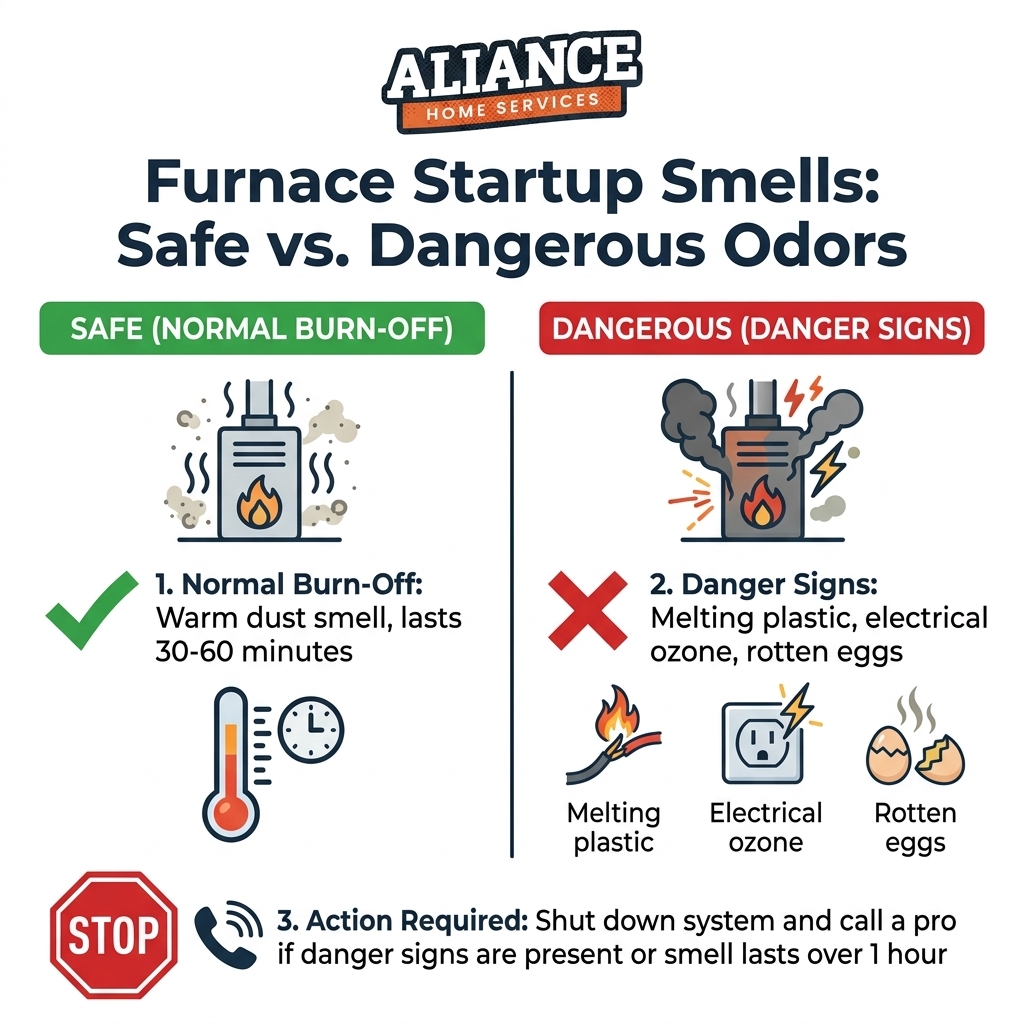
Knowing when to observe and when to act is the most critical decision point for any property owner. If your system exhibits signs of distress, decisive action protects both your equipment and your property.
If you determine that the odor is not a standard dust burn-off, follow these critical steps to secure your heating system:
1. Turn off the thermostat: Immediately switch your thermostat from "Heat" to the "Off" position to stop the call for combustion.
2. Cut the power: If the blower motor continues to run and the electrical smell persists, locate your electrical panel and flip the dedicated breaker for the furnace to the "Off" position.
3. Check smoke and carbon monoxide detectors: Ensure your safety alarms are functional. If any alarms trigger, evacuate the property immediately.
4. Contact a professional: Reach out to a certified HVAC technician to perform a thorough diagnostic of the heat exchanger, blower assembly, and electrical relays.
Ignoring a heating anomaly is just as risky as ignoring a failing cooling system. For example, our team recently helped a local customer whose 20-year-old central AC unit was struggling during summer. It ultimately required a full replacement—which we professionally installed and relocated to a shadier spot to improve efficiency. Just as you wouldn't ignore a failing system needing Commercial AC Repair in Milwaukee, heating anomalies demand prompt attention.
Addressing these issues early prevents cascading failures. A certified technician can safely resolve underlying issues—such as replacing a failing capacitor or cleaning a clogged burner—without voiding your manufacturer warranties. Prompt professional intervention ensures that a minor electrical short doesn't evolve into a complete system replacement.
The specific startup problems we handle every October in our region point to a broader necessity: proactive, climate-aware HVAC maintenance. The unique environment of the upper Midwest demands more than just reactive repairs.
Port Washington and Milwaukee's unique climate puts extra stress on both residential and commercial HVAC systems. The high relative humidity during summer and early fall doesn't just make dust stick to the heat exchanger; it also impacts overall indoor air quality (IAQ). When damp air circulates through dormant ductwork, it creates an environment susceptible to poor air quality. Pre-season maintenance clears away this summer dust accumulation before that first startup, ensuring that the air pushed into your living spaces or commercial offices is clean and healthy.
When our crews perform a comprehensive fall tune-up, the process involves much more than simply changing the air filter. Professional inspections verify that heat exchangers are completely intact, free of microscopic cracks that could leak carbon monoxide. Technicians also ensure that all electrical connections, which may have vibrated loose during the heavy summer cooling season, are tightened and secure.
For properties utilizing older, inefficient units, these seasonal transition issues often become more frequent and severe. In many cases, consulting a professional about Commercial HVAC System Installation & Upgrades can mitigate these recurring odors entirely. Modern, high-efficiency systems feature advanced sealed combustion chambers and variable-speed blowers that handle seasonal transitions with significantly less strain and odor.
To help you navigate the seasonal transition safely, here are direct answers to the most common questions property owners ask when turning on the heat for the first time.
It is typically normal for a heater to smell like burning for 30 to 60 minutes during the first use of the season. This brief window allows the system to reach its peak operating temperature and vaporize the dust that settled over the summer. You should notice the smell steadily decreasing in intensity during this time. If the odor remains strong after an hour, it requires professional attention.
You should not be worried initially if the odor smells simply like warm, dry dust. This is a standard mechanical process for any furnace waking up from dormancy. However, worry is entirely justified if the air smells like melting plastic, electrical ozone, or if the odor lasts longer than an hour. Those specific scents point to mechanical or electrical failures rather than harmless dust.
If your furnace smells like burning plastic, shut the system off immediately at the thermostat. This acrid smell usually means a foreign object has found its way into the ductwork or a wire's protective insulation is melting due to an electrical short. Do not attempt to open the unit or investigate the combustion chamber yourself; call a licensed HVAC professional immediately to diagnose the hazard safely.
We strongly recommend calling a professional if the burning smell persists beyond the first hour of continuous operation. Additionally, you must request emergency service if you detect any chemical, electrical, metallic, or rubbery odors at any point during the heating cycle. A certified technician has the diagnostic tools necessary to locate hidden electrical shorts or cracked heat exchangers that produce these dangerous scents.
Yes, the higher humidity associated with Lake Michigan causes dust and dander to stick much more firmly to dormant heating components. Instead of loose dust blowing away, the damp air bakes the debris onto the metal heat exchanger. When the system ignites in October, this adhered layer requires more intense heat to vaporize, resulting in a stronger, more noticeable burn-off odor than you would experience in a drier climate.
Yes, commercial rooftop systems also accumulate dust and environmental debris during their summer dormancy. Because these units are exposed to the outdoor elements on a roof and move significantly larger volumes of air, the initial dust burn-off can be quite pronounced. Their larger scale often requires specialized, preventative commercial maintenance to ensure the burn-off doesn't cause widespread indoor air quality complaints among tenants.
Understanding the mechanical reasons behind that first frosty October night's burning smell is the first step in responsible property management. Knowing the distinct differences between normal seasonal dust burn-off and a genuine electrical hazard brings profound peace of mind as the temperatures drop. You should never have to guess whether your heating system is operating safely.
If you detect persistent odors, electrical scents, or simply want to ensure your system is clean and calibrated for the long Wisconsin winter, do not take chances with your safety. Schedule a comprehensive pre-season inspection with our local experts today to guarantee your home or business remains warm, safe, and efficient all season long.
Industry-leading ductless mini-split systems for targeted zone control