HVAC Blogs
View All
info@alianceheatandcool.com
24/7 Emergency Service Available


In our years serving Port Washington and the surrounding communities, a common myth we hear from homeowners is that a single sweep of the vents will permanently cure a chronically dusty house, which is exactly why our team at Aliance Home Services prioritizes advanced air filtration over basic duct cleaning before fall. Many people assume that if they physically remove the dust sitting inside their ductwork, the air blowing out of their vents will stay perfectly clean for the rest of the year. The reality is far more complex. As early fall approaches and the pre-heating season begins, homes experience a massive influx of airborne particles. September ragweed pollen peaks right as temperatures start to drop, combining with everyday household dust just as heating systems turn on for the first time.
If you are tired of constantly dusting your furniture only to see a new layer settle the very next day, you are facing a critical decision point. You have to choose between a temporary cleanout of settled debris or upgrading your home's continuous filtration capabilities. From what we see in the field every day, true air quality improvement requires addressing the root cause of circulating particulates, rather than just treating the symptoms. That is why indoor air quality solutions often require a more comprehensive approach than standard air duct cleaning, especially when you want long-term results.
When our technicians inspect residential systems, we find it helps to explain the mechanical reality of what a standard duct sweep actually accomplishes to help you make the best decision for your home. A basic sweep is a physical maintenance step. It uses agitation and vacuum pressure to remove heavy, settled debris that has already fallen out of the airstream and collected on the floor of your ductwork. This is a valuable service for specific situations, but it is not a comprehensive solution for ongoing indoor air quality problems.
For example, one homeowner recently reached out to us during a routine seasonal transition, requesting both duct work cleaning and an AC tune-up. Our Aliance Home Services technicians performed the duct cleaning and AC tune-up with professional, knowledgeable, and friendly service. The customer was thrilled, noting we did a spectacular job and that they were looking forward to their future furnace tune-up. However, during that visit, we also took the time to explain to these homeowners in Saukville that while the ducts were now spotless, the true defense against returning dust lies in the filter.
What standard cleaning misses:
• Microscopic particulates: Sweeping targets heavy debris like pet hair, construction dust, and large lint particles. It does not effectively capture the microscopic allergens that remain suspended in the air.
• Continuous generation: Dust is generated constantly by shedding skin, pets, cooking, and outdoor air infiltration. A clean duct does nothing to stop new dust from forming.
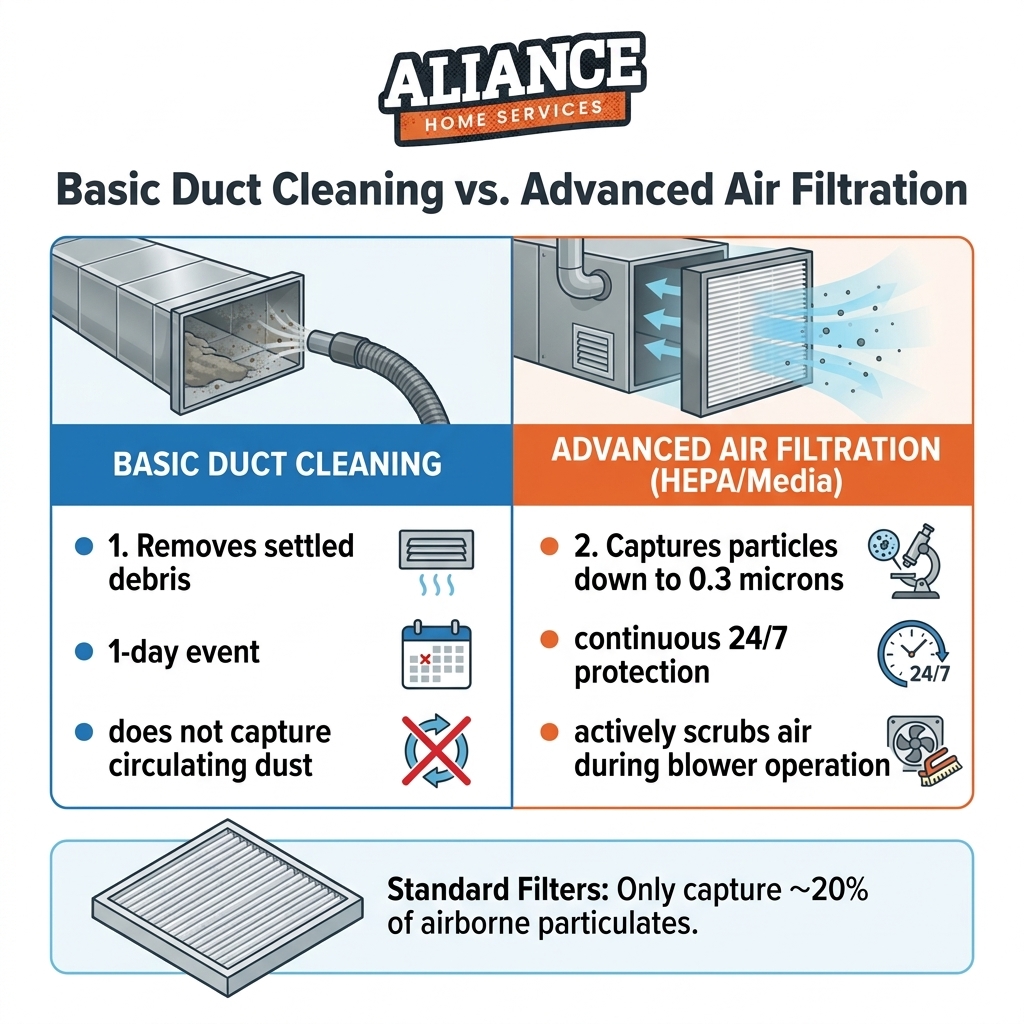
• Filter bypass: Standard one-inch fiberglass filters only capture about 20% of airborne particulates. The remaining 80% bypasses the filter, circulates through your rooms, and eventually resettles in your freshly cleaned ducts.
The Environmental Protection Agency (EPA) explicitly states that duct cleaning alone has not been shown to prevent health problems, nor does it guarantee that dust will not return. At Aliance Home Services, we view the common early fall request for a duct sweep as a perfect opportunity to look deeper into the overall health and filtration capacity of your HVAC system.
Our team often explains that the primary limitation of a one-time sweep is that the debris removal is entirely temporary if the source of the dust is not managed. Your ductwork is simply the highway for your home's air. If you sweep the highway but leave the tollbooth wide open for new vehicles, traffic returns immediately.
Without active, high-efficiency filtration in place, new particulates begin circulating the very moment your furnace blower turns back on. You might enjoy a brief reduction in large dust clumps, but the fine, powdery dust that coats your televisions and bookshelves will continue to accumulate. In our experience working in Saukville and Port Washington homes, we consistently see that relying solely on seasonal sweeps leads to frustration when the dust returns just weeks later.
The urgency of addressing your air filtration in early fall comes down to building science and seasonal weather patterns. During the summer, you might occasionally open windows to let in a breeze, allowing stale indoor air to escape and fresh outdoor air to dilute indoor pollutants. However, the upcoming weather drastically alters how air circulates through your living spaces.
Here in Wisconsin, crisp autumns quickly transition into harsh, cold winters. As local HVAC professionals, we know firsthand that to maintain energy efficiency and keep your family warm, your home must be tightly sealed against the freezing temperatures. For five to six months out of the year, windows stay locked, doors are opened only briefly, and fresh air exchange drops to near zero. Your house becomes an airtight envelope.
The compounding effect of winter lock-in:
• Trapped allergens: Pet dander, dust mites, and late-fall allergens have nowhere to go. They continuously recirculate through your HVAC system.
• Increased indoor activities: Families spend more time indoors during the winter, generating more dust through movement, cooking, and shedding clothing fibers.
• Dry air suspension: Winter air is naturally drier, which allows fine particulate matter to stay suspended in the air longer before settling, making it easier to inhale.
This tightly sealed environment traps pollutants indoors, rapidly compounding poor indoor air quality symptoms. Our technicians emphasize that if you enter the pre-heating season without a plan to actively scrub the air, you are essentially locking yourself inside a sealed box with every particle of dust generated over the winter. Addressing this before the deep freeze hits is critical for maintaining a clean, comfortable environment for your family.
When our customers ask for a permanent, mechanical solution to chronic household dust, we recommend shifting your strategy from reactive cleaning to proactive, 24/7 air scrubbing. Advanced air filtration systems are installed directly into your HVAC ductwork, usually right before the air enters the furnace or air handler. This ensures that every single cubic foot of air is cleaned before it is conditioned and blown back into your living spaces.
For our neighbors in the Port Washington area, our team has found that upgrading to an advanced system is the most effective way to maintain pristine air quality. Here is exactly how these systems actively clean your home:
1. High-Efficiency Media Upgrades: Advanced filtration starts with replacing the flimsy, one-inch fiberglass filter with a deep-pleated media cabinet. These filters are typically four to five inches thick, providing a massive surface area to trap particles without restricting airflow.
2. Microscopic Capture Rates: According to ASHRAE standard 52.2, higher MERV (Minimum Efficiency Reporting Value) ratings indicate a greater ability to capture microscopic allergens. Whole-home HEPA systems and high-MERV media filters can capture particles as small as 0.3 microns—including smoke, bacteria, and ultra-fine dust that standard filters miss entirely.
3. Continuous Scrubbing Cycle: Every time your furnace blower motor turns on, the air in your home is pulled through the advanced filter. It actively scrubs the air, removing contaminants hour after hour, day after day.
4. Equipment Protection: By capturing the dust before it reaches the furnace, advanced filtration keeps your blower motor, heat exchanger, and evaporator coils perfectly clean. This prevents overheating and ensures your system runs at peak efficiency all winter long.
Instead of hoping your ducts stay clean after a one-time service, an advanced filtration system guarantees that the air traveling through those ducts is constantly being purified.
To help you make an informed decision for your early fall home maintenance, we like to show our customers a clear, side-by-side evaluation of both approaches. While both services involve your ductwork, their long-term impacts on your daily life are vastly different.
• Timeline of Impact — Basic Duct Sweeping: A one-day cleanout of existing debris. — Advanced Air Filtration: Months of continuous, 24/7 particulate capture.
• Primary Target — Basic Duct Sweeping: Heavy, settled debris, pet hair, and large objects. — Advanced Air Filtration: Microscopic circulating dust, pollen, dander, and smoke.
• Prevention — Basic Duct Sweeping: Does not prevent new dust from forming or circulating. — Advanced Air Filtration: Actively stops new dust from circulating through the home.
• Equipment Benefit — Basic Duct Sweeping: Minimal impact on the internal furnace components. — Advanced Air Filtration: Keeps the blower motor and coils permanently clean, extending lifespan.
• Frequency — Basic Duct Sweeping: Recommended only every few years as needed. — Advanced Air Filtration: Filters are replaced every 6 to 12 months for ongoing protection.
Our technicians frequently speak with homeowners who are frustrated by recurring dust. Another customer recently required assistance with a persistent HVAC issue. By providing professional, knowledgeable, helpful, and trustworthy service, our team diagnosed that their system was heavily burdened by bypassing dust. Instead of just selling them another temporary cleanout, we explained how upgrading their filtration would permanently resolve the recurring complaints of dusty surfaces.
This reflects the Aliance Home Services core commitment to solving the root cause of poor indoor air quality. We refuse to just sell temporary fixes when a permanent solution is needed. While we agree that duct sweeps absolutely have their place for heavy contamination—such as after a major home renovation or moving into a newly constructed house—we firmly believe filtration is your daily, reliable defense mechanism against everyday dust.
When we install new indoor air quality equipment, we always highlight how modern technology allows you to maximize the effectiveness of advanced filtration systems without constantly adjusting your thermostat. The secret to maintaining excellent air quality throughout the harsh winter is keeping the air moving. If your furnace only runs when the house needs heat, the air is only being filtered during those active heating cycles.
By managing your smart thermostat ecosystem, you can take complete control of your home's air quality.
Smart integration strategies include:
• Continuous Fan Settings: Modern smart thermostats feature a "circulate" mode. This setting runs the furnace blower motor at a low, energy-efficient speed even when the heat is off. This ensures your air is continuously passing through the advanced filter, scrubbing it 24/7.
• Filter Life Monitoring: Advanced thermostats track exactly how many hours your blower motor has run, rather than just relying on a calendar. They send you an alert exactly when your media filter has reached its capacity and needs replacing.
• System Health Alerts: If a filter becomes too clogged, it can restrict airflow. Smart controls monitor static pressure and will alert you before a dirty filter can cause your furnace to overheat or shut down.
Taking control of your home's ecosystem with smart controls and advanced filtration ensures that you enter the pre-heating season in Saukville and Port Washington with absolute confidence in your air quality. As an added bonus, upgrading your home's efficiency can sometimes qualify you for generic utility incentive programs or energy tax credits, though we always recommend verifying current programs with your local utility provider or a tax professional.
While duct cleaning removes settled debris from inside your vents, the EPA notes it has not been proven to significantly improve daily indoor air quality on its own. In our professional experience, for true air quality improvement, you must capture the microscopic particles that circulate in the air, which requires high-efficiency filtration.
Our team recommends installing a whole-home advanced media filter or HEPA system as the most effective way to reduce household dust. These systems actively trap fine particulate matter every time your HVAC blower runs, preventing the dust from settling on your furniture and floors.
Yes, for ongoing dust management, we find a whole-home air filter is far superior. Duct cleaning is a temporary physical removal of existing heavy debris, whereas an advanced filter provides continuous, 24/7 protection against incoming dust, pollen, and pet dander.
An air purifier and duct cleaning serve different purposes, but a high-quality purifier addresses the root cause of poor air quality. If we inspect your ducts and find them severely contaminated with mold or construction debris, a sweep is necessary. However, for everyday dust control, an air purifier is the better long-term investment.
We advise replacing standard one-inch fiberglass filters every 30 days, especially during winter when the furnace runs frequently. If you upgrade to a four-inch or five-inch advanced media filter, you typically only need to replace it every 6 to 12 months, depending on household factors like pets and smart thermostat run-time.
Understanding the mechanical difference between treating a symptom and solving a root cause empowers you to make better home maintenance decisions. While sweeping out your vents might feel like a productive early fall chore, we've seen time and time again that it simply cannot compete with the continuous, active scrubbing power of a dedicated filtration system.
As you prepare your home for the long winter ahead in Saukville and Port Washington, investing in advanced filtration gives you the peace of mind that your family will be breathing clean, healthy air all season long. Our team at Aliance Home Services encourages you to explore your options for upgrading your home systems before the deep freeze sets in. Why we prioritize advanced air filtration over basic duct cleaning before fall comes down to one simple fact: we want you to enjoy permanent comfort, not just a temporary fix.
Industry-leading ductless mini-split systems for targeted zone control